
Webinars
Webinars, virtual panels and masterclasses with experts
We regularly organise webinars and masterclasses on the topics that are hot on the agenda of EV charging professionals. Integrating battery storage, handling grid constraints, or staying compliant to complex local regulations: discover conversations that will enable your business to stay ahead of competition
All events

Webinar
The 2027 BeNeLux grid playbook: new DSO rules for charging sites
New grid rules are reaching charging sites across Belgium and the Netherlands, and CPOs need two answers: how do I comply, and what happens to my chargers when the grid operator limits capacity? This webinar answers both.
Grid operators in Belgium and the Netherlands are changing the rules for charging sites. Fluvius now connects most new sites in Flanders on flexible terms, and the six Dutch regional DSOs are introducing capacity limits for public charging this winter. For new sites in congestion zones, no integration means no energisation.
The requirements are new to most CPOs. Belgium combines real-time control over a local IEC connection with day-ahead limits over OpenADR, while Dutch DSOs plan capacity limits over OpenADR. Get the setup wrong and your rollout stalls, or your chargers slow down every time the grid is under pressure.
FLEXECHARGE connects your sites to these grid operators with one setup across both countries. The strictest limit is always applied on site, and where there's a battery, it takes the reduction before your chargers do.
In this webinar, Robert Brehm, co-founder and CTO of FLEXECHARGE, walks through what Fluvius and the Dutch DSOs require, how the setup works in practice, and what to prepare for in 2027.
Get DSO-ready now and keep your chargers running.
→ Register now
What you will learn:
- what Fluvius and the Dutch regional DSOs require from charging sites, and on what timeline
- how real-time IEC control and day-ahead OpenADR limits work together, and why the strictest limit always wins
- what the technical setup involves, from DSO signals and measurements to the acceptance test at commissioning
What this means for your rollout:
- You can sign a flexible connection or new grid contract knowing what's required and what happens to your site when capacity is limited.
- Where a battery is on site, it absorbs the reduction first and helps protect charging availability.
- The same setup works across Belgium and the Netherlands, and the flexibility you commit can become an extra revenue stream.

Webinar
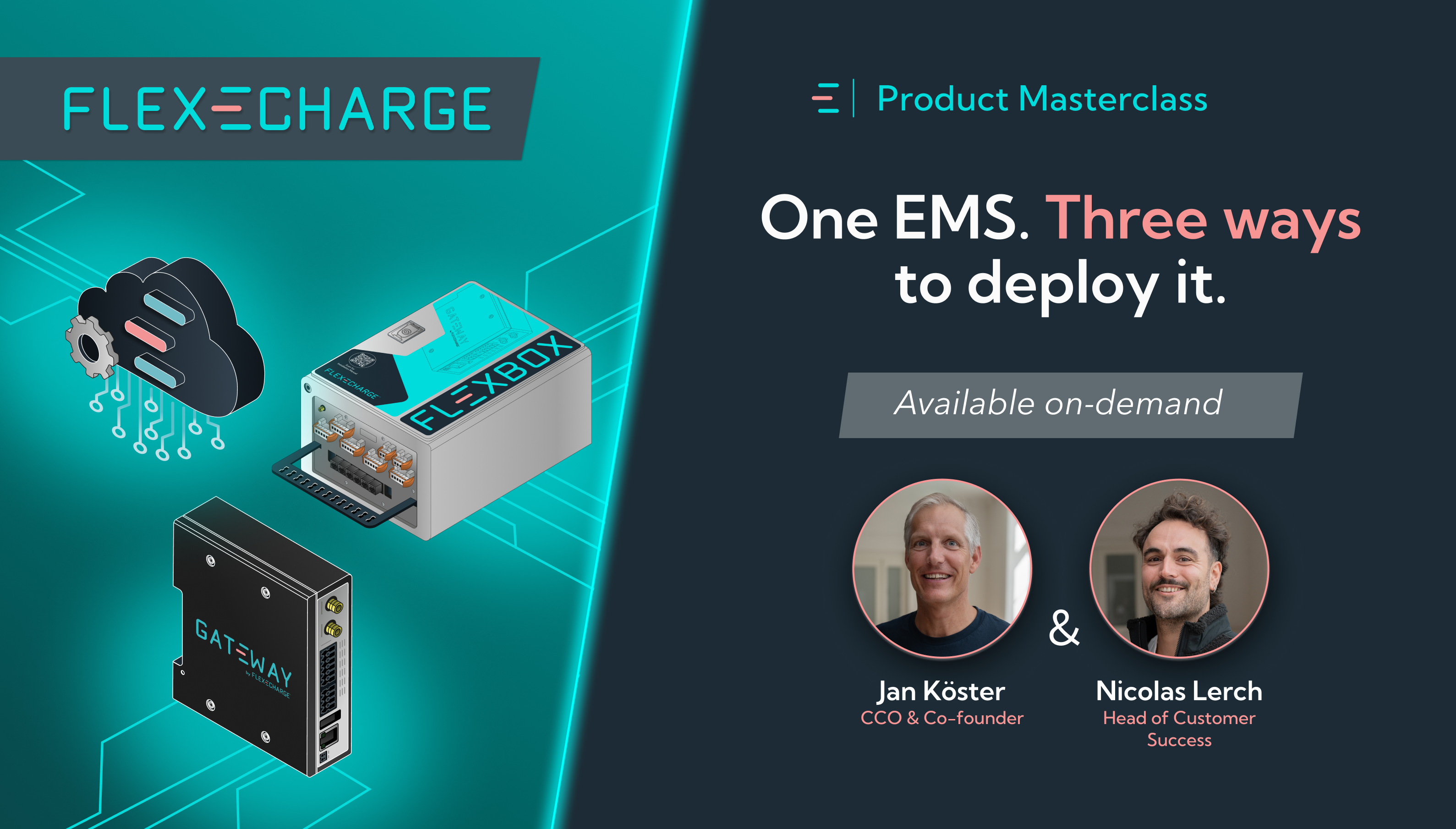
One EMS, Three Ways to Deploy It
One site runs fine on the cloud. Another has a battery talking to a DSO in real time, in a country with its own curtailment rules. Pick the wrong architecture and you pay for it twice: once in complexity, once in downtime.
Not every charging site needs the same setup. A single connector in a car park runs fine on cloud-managed control. A multi-asset hub with a battery, solar and a DSO curtailment signal does not.
CPOs that default to one architecture across the whole portfolio end up over-engineering the simple sites and under-serving the complex ones. Ignoring that DSO rules and grid requirements differ by country makes it worse. The fix isn't more hardware everywhere. It's matching the control layer to what the site, and the market it's in, actually needs.
A CPMS only gets you halfway. It manages the charge points, but the moment you need a battery, solar, or a DSO signal working alongside them, a CPMS-only setup runs out of road. That's where FLEXECHARGE comes in: we cover the full asset stack, not just the charger.
FLEXECHARGE runs energy management three ways: in the cloud, on a local GATEWAY, or inside a standardised FLEXBOX that bundles local execution, DSO interfaces and site networking into one unit. One EMS, three ways to deploy it, so the architecture fits the site instead of the other way round.
DSO requirements are coming, and batteries are coming with them. Sites that look simple today won't stay that way. Be ready with an EMS that already integrates everything, whichever deployment option the site ends up needing.
In this masterclass, Nicolas and Jan walk through when each option applies and why, using a decision tree and three real site types, from a simple charging location to a regulated, multi-asset hub.
FLEXECHARGE gives you one EMS, built to run the way each site actually needs it to.
→ Register now
What you will learn:
- what role Cloud, the GATEWAY and the FLEXBOX each play in a HARMON-E deployment
- when a site needs local, offline-capable control instead of cloud
- how DSO signals, country rules and site assets change which architecture fits
What this means for your rollout:
- You stop guessing site by site and start from a framework that already accounts for DSO and country differences.
- Commissioning takes less back-and-forth because the architecture already matches what the site needs.
- Standardisation happens where it can, without forcing complex sites into a setup they'll outgrow.
Webinar
Scaling Load Management with HARMON-E Headless
For a top-tier CPO, the limit isn't what your energy platform can do. It's whether it runs programmatically, at scale, inside your own systems. See how HARMON-E Headless closes that gap.
For a top-tier CPO running thousands of charge points across brands, markets, and hardware vendors, the limit isn't what your platform can do. It's whether it runs programmatically, at your scale, inside your own systems.
Increasingly, the thing doing that isn't a person, it's your own AI agents and analytics. Which leaves one question: can your platform be run by software?
That's the gap HARMON-E Headless closes: the same Enable, Optimise, and Aggregate capabilities, exposed as three building blocks over one HARMON-E Datalake. Configure sites in bulk. React to events in real time. Feed your own BI and AI tools directly, so they run the network instead of just reporting on it.
The grid utilisation gains, avoided upgrades, and flexibility revenue HARMON-E already delivers become repeatable across your whole portfolio, and measurable in your own analytics. No dashboard. No lock-in.
In this masterclass, we'll show what that looks like in practice: what you can build on FLEXECHARGE, what stops being manual once the API handles it, and where the platform takes over entirely.
One example: API Presets let you define a site setup once and apply it anywhere, without re-entering the same configuration by hand.
FLEXECHARGE becomes infrastructure you build on, not just a tool you log into.
→ Register now
What you will learn:
- what running FLEXECHARGE headless means day-to-day, and what becomes possible once you build on the API instead of the interface
- how configuration, monitoring, and site management shift when they run through your own systems instead of ours
- how API Presets turn repeated, per-site setup into a one-time definition you apply anywhere
What this unlocks as you scale:
- Your team stops watching a dashboard and starts hearing about problems the moment they happen, across a portfolio of any size, through your own systems.
- Onboarding becomes a portfolio-wide action instead of a per-site one, so growing from 50 sites to 500 doesn't mean growing your ops headcount to match.
- Your reporting runs on your own BI stack instead of ours, so performance data fits however your organization already tracks it, not how we've built our dashboard.
Webinar
FLEXBOX - Standardisieren statt neu erfinden: so skalieren die besten CPOs ihre Rollouts mit Verteilnetzbetreibern
Nehmen Sie an unserem Produkt-Webinar teil und erfahren Sie, wie FLEXBOX CPOs dabei unterstützt, die Einhaltung der Netzvorschriften in Deutschland und Österreich zu vereinfachen. Erfahren Sie, wie standardisierte Plug-and-Play-Hardware eine schnellere Einführung von EV-Ladestationen ermöglicht, den Betriebsaufwand reduziert und die Grundlage für eine skalierbare, netzkonforme Ladeinfrastruktur schafft.
Die besten CPOs denken Inbetriebnahmen nicht jedes Mal neu. Sie setzen auf Standardisierung.
Lernen Sie die FLEXBOX kennen.Netzsteuerungs-Vorgaben in Deutschland und Österreich bremsen den Ausbau der Ladeinfrastruktur für Elektrofahrzeuge. Unterschiedliche Netzbetreiber, unterschiedliche Vorgaben, unterschiedliche Hardware – dadurch wird Skalierung schnell komplex.
Genau deshalb haben wir die FLEXBOX entwickelt.In diesem Webinar zur Produkteinführung stellen wir eine neue Plug-and-Play-Hardwareeinheit vor, die CPOs dabei unterstützt, genau das zu vereinheitlichen, was sich bisher kaum vereinheitlichen ließ.
Die FLEXBOX wurde entwickelt, um Netzsteuerung zu vereinfachen, Installationen & Inbetriebnahmen wiederholbar zu machen und den betrieblichen Aufwand zu verringern, der viele Rollouts beim Wachstum ausbremst.
Sie markiert einen grundlegenden Fortschritt im Umgang mit Netzsteuerungs-Vorgaben – und zeigt einen neuen Ansatz dafür, wie diese in Zukunft funktionieren sollten: damit Teams heute schneller umsetzen und morgen zusätzlichen Mehrwert erschließen können.
→ Jetzt anmelden
Was Sie lernen werden:
• was erfolgreiche CPOs für nachhaltiges Wachstum brauchen – darunter standardisierte Rollouts, operative Exzellenz und eine stabile, offene Systemlandschaft
• warum Netzsteuerungs-Vorgaben die Skalierung erschweren und Standardisierung in Deutschland und Österreich häufig ausbremsen
• wie führende CPOs netzsteuerungskonforme Standorte mit einem wiederholbaren und bewährten Rollout-Modell umsetzen
• wie die FLEXBOX schnellere, einfachere und einheitlichere netzsteuerungskonforme Inbetriebnahmen ermöglicht
• wie die FLEXBOX und HARMON-E Installation & Inbetriebnahme, Überwachung und täglichen Betrieb über mehrere Standorte hinweg unterstützen
• wie Netzsteuerungs-Vorgaben zur Grundlage für Flexibilität, virtuelle Kraftwerke und zusätzliche Erlösmodelle werden

FAQ
What you'll learn in these webinars
How long does the webinar last?


Our webinars typically last between 45 and 60 minutes, including time for Q&A. Some masterclasses or panel discussions may run slightly longer depending on the depth of the topic and audience interaction.
What topics are covered in FLEXECHARGE Masterclasses?
FLEXECHARGE Masterclasses focus on advanced EV charging and energy management topics relevant to Charge Point Operators and industry professionals.
These include:
- Load and energy management strategies
- Grid constraints and compliance with local regulations
- Integration of battery storage and renewable energy
- Virtual Power Plants (VPP) and new revenue streams
- EV charging architecture (e.g. OCPP broker systems)
- Real-world deployment cases and best practices
The sessions are designed to help professionals optimise operations, scale infrastructure, and stay ahead of industry challenges.
Is the recording sent after the webinar?
Yes, if you register for a webinar, you will typically receive access to the recording afterward. Many of our sessions are also available as on-demand webinars, so you can watch them at your convenience.
Who are FLEXECHARGE webinars for?
Our webinars are designed for Charge Point Operators (CPOs), energy managers, installers, and e-mobility professionals looking to optimise EV charging infrastructure and better manage energy usage. Whether you're scaling a network or improving performance, our sessions provide practical insights.
Are the webinars free to attend?
Yes, all FLEXECHARGE webinars and masterclasses are free of charge. Our goal is to share knowledge and support the growth of smarter, more efficient EV charging infrastructure.
Can I ask questions during the webinar?
Absolutely. Most sessions include a live Q&A segment, and you’re encouraged to submit questions throughout the webinar. Our experts will address as many as possible during the session.
How do I join the webinar after registering?
Once you register, you’ll receive a confirmation email with your access link. You’ll also get a reminder before the session starts, so you can easily join at the scheduled time.
Discover the FLEXBOX in our on-demand webinar

Get in touch with our experts
