Episode 60
Episode 60 – Zero Downtime and Safer CPMS Migrations: Why CPOs Need Broker Forking – with FLEXECHARGE
One Charger, Three Backends
Charging infrastructure is usually judged by what you can see: the chargers, the power cabinets, the grid connection. Yet behind every session sits a backend connection that authorises transactions, sends remote commands and monitors the site. In the classic setup, each charger talks to a single CPMS over OCPP, and that one link quietly carries the whole operation.
That dependency is becoming harder to accept. Electric bus and logistics depots cannot afford to stop charging because an internet connection fails. At the same time, consolidation across Europe means more CPOs are taking over networks that run on different backends, turning every CPMS change into a risky migration project.
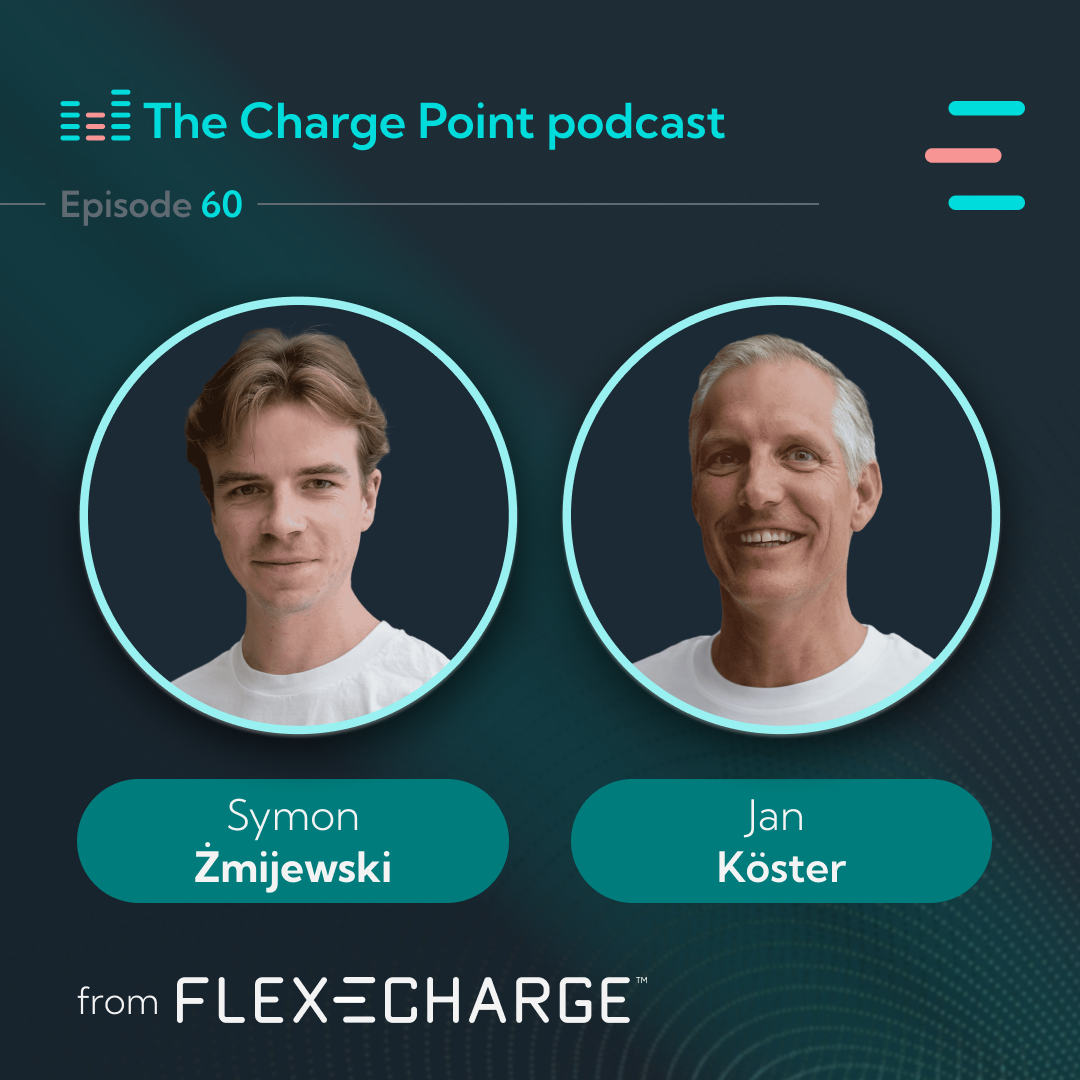
Christophe Lephilibert speaks with Szymon Żmijewski, Software Developer at FLEXECHARGE and the engineer behind broker forking, and Jan Köster, CCO and Co-founder of FLEXECHARGE. Broker forking was developed in close collaboration with Daimler Buses. It lets an OCPP proxy connect each charger to a primary, a fallback and a service backend at once, so sessions keep running when the primary goes offline.
The conversation moves from the engineering detail of keeping three backends in sync to the bigger market picture: why CPOs are specialising, why standardisation decides who leads consolidation, and why backend resilience is becoming part of the core infrastructure decision.
What You Will Learn in This Episode
Szymon and Jan walk through the architecture, the lessons from a real depot deployment, and what it means for CPOs planning their next migration.
- What single point of failure does the one-charger, one-backend model create, and what happens to a site when that connection drops?
- How do the primary, fallback and service backends split responsibilities in a broker forking setup?
- Why is preserving transaction state, not reconnecting, the hardest part of backend redundancy?
- How does a mapping layer reconcile three different OCPP 1.6 transaction IDs for a single charging session?
- How can CPOs use broker forking to move charge points to a new CPMS gradually after an acquisition?
- Why can an OCPP proxy with forking match the reliability of a direct Modbus integration?
Expert Insight
"When we discuss architectures, Modbus versus OCPP proxy with the forking, we brought the proxy up on a reliability level that matches the Modbus integration with the charger."
- Jan Köster, CCO & Co-founder, FLEXECHARGE
Listen for free wherever you get your podcasts