
When the Cable Won't Come, Bring a Battery
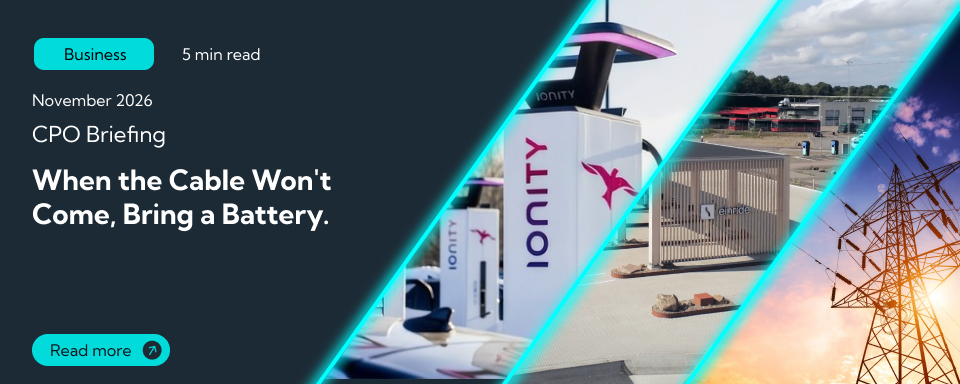
When the Cable Won't Come, Bring a Battery
In the past month, the grid moved from background constraint to the centre of the CPO business case. Brussels agreed to cut permitting times, German storage developers raced a grid-fee deadline, and British operators watched fixed grid charges push the price at the plug towards £1/kWh. The operators pulling ahead are the ones that treat their grid connection as an asset to manage.
The month in 60 seconds
- Grid access is getting faster, on paper. The EU's provisional grids deal raises permit thresholds and exempts chargers up to 1 MW on artificial structures, but national law will take until around 2028.
- Storage is becoming standard CPO kit. Ionity switched on its first site battery and plans around 50 more in 2027, while more than 4 GWh of German grid-scale storage moved towards construction in a single week.
- Fixed grid costs now shape prices. A UK rapid charger pays £440 a week in standing charges before selling a single kWh, while Dutch grid operators now sign contracts with CPOs to slow charging when the grid is congested.
In this edition
- Keep it running: uptime and utilisation, from Deutschlandnetz to Power Dot's repair centre.
- This month's key numbers: five figures that sum up the month.
- Make it pay: grid and DSO news, storage and flexibility.
- Depots and trucks: flexibility markets, motorway truck sites and shared depots.
- Deals and financing: who bought, sold and raised money.
- CPOs' note: what it all means for CPOs.
- Events in the next 90 days: deadlines and events to put in your calendar.
Keep it running
Uptime and utilisation decide whether installed power earns money, and this month the gap between operators became measurable.
Deutschlandnetz: a five-fold spread inside one programme
Germany's state-backed Deutschlandnetz fast chargers were occupied 5.9% of the time in October, against 10.4% for all German DC chargers, according to an analysis of ChargePointRadar data reported by Chargalytics. Inside the programme, Fastned and Autostrom plus logged around 150 sessions per charge point that month, while Allego averaged 29. Same subsidy framework, same motorway logic, five times the activity. The spread suggests that how a site is run and priced matters as much as where it sits.
Recharge: a site that grew thirteen-fold
Recharge's site at a McDonald's in Kristinehamn, Sweden, delivered about 24 MWh in 2019 and nearly 319 MWh in 2025. Utilisation does grow with the EV fleet. The question every operator should ask about a site like this is whether the original grid connection can carry year seven, or whether it becomes the bottleneck.
Ionity: hardware that keeps failing gets replaced
Ionity stopped a pilot at Elverum, Norway, where shared-power chargers of up to 500 kW from Ekoenergetyka had suffered repeated faults, and installed Huawei units in their place. It is Ionity's first work with Huawei. Procurement teams will watch the supplier choice, but the signal for operators is simpler: a site that keeps breaking down loses its drivers, and large networks now act on that quickly.
Power Dot: uptime starts in the warehouse
Power Dot showed its repair centre in Porto, featured by the Portuguese broadcaster RTP. The company keeps its own stock of replacement components, so technicians do not wait for parts to be shipped. How fast a charger comes back after a fault depends on how fast the part arrives, which makes spare-parts logistics a direct uptime lever.
What it means: faster permits (see below) will raise the stakes on utilisation. Track sessions per charge point by site, set a clear time-to-repair target, and check which sites will hit their grid limit as demand grows.
This month's key numbers
Five figures that sum up the month for CPOs.
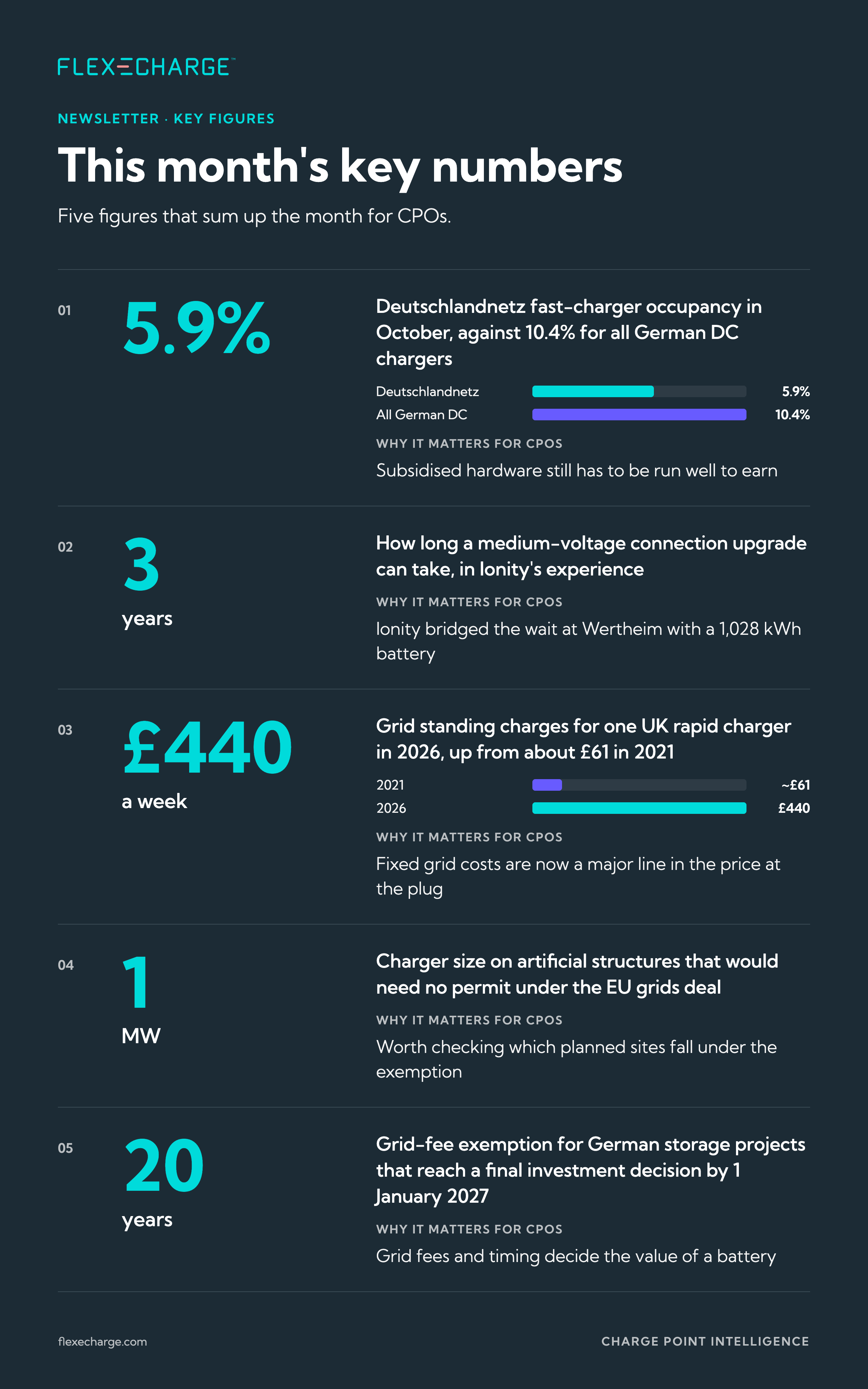
Sources for each figure are in the sections around it and in the Sources list.
Make it pay
The grid connection is now the biggest single lever on CPO margins: how fast you get it, what it costs every week, and how much more it can deliver with storage and flexibility.
Grid and DSO desk
EU grids package: faster permits, with a 2028 horizon. On 18 November, the Parliament and member states reached a provisional deal on faster permitting. The threshold at which chargers, storage and small solar need approval rises from 100 to 200 kW, and charging stations of 1 MW or less on “artificial structures” will need no approval at all. Nobody has yet defined what an artificial structure is. Approval of standalone storage and charging stations gets a maximum of six months, and member states can treat an authority's silence as approval. The deal still needs formal sign-off, and countries then have 18 months to transpose it, so most operators will feel the effect from around 2028.
Netherlands: the grid gets a say in charging speed. Since 12 November, grid operators in Utrecht, Gelderland and the Flevopolder can temporarily slow down or pause public charge points when the local grid is under strain, mainly between 06:00 and 11:00 and between 15:00 and 22:00. The requests run through GOPACS, the Dutch congestion platform, under contracts with CPOs, who then adjust groups of chargers. It is a template other congested markets are likely to copy.
UK: the standing-charge squeeze. An assessment by the operator Zest and The Fast Charge puts grid standing charges for one rapid charger at £440 a week in 2026, up from about £61 in 2021, and around £540 a week in 2027. Chargalytics estimates that at roughly £23,000 a year per charger. Networks now warn that UK public rapid charging could pass £1/kWh before VAT in 2027, from an average of 79p today, while a cut to the ZEV mandate is expected within weeks. Two reform proposals for these charges have been in working groups for three years.
France: skipping the transformer. Greenspot plans 30 retail sites by the end of 2027, each with four charge points sharing 200 kW on a standard commercial tariff and without a dedicated transformer. Smaller connections, shared power and months saved per site.
Storage and flexibility
Ionity puts a battery where the cable is missing. Ionity has switched on its first site battery at Wertheim, Germany: a 1,028 kWh Sungrow system with up to 500 kW, which let it add charge points while a medium-voltage upgrade is pending. Ionity says such upgrades can take up to three years. It plans around 50 site batteries across Europe in 2027, with more than 20 MWh in total. Hemsbach is next, with 12 charge points, a solar canopy of more than 223 kWp and a battery of more than 2 MWh.
E.ON at Spijkenisse: 50 kW in, 285 kW out. E.ON Drive Infrastructure reported that its battery-backed site in Spijkenisse, the Netherlands, peaked at 285 kW on a 50 kW grid connection. It is the clearest example this month of storage turning a weak connection into a fast-charging site.
Germany's battery rush. More than 4 GWh of large storage projects, including EnBW's, moved towards construction in a single week. The driver is a deadline: projects that prove a final investment decision by 1 January 2027 qualify for a 20-year exemption from grid fees on charging and discharging. Expect more announcements before the end of the year.
Drivers paid to stay plugged in. E.ON and BMW extended their vehicle-to-grid offer to the new i3, iX4 and iX5. Drivers get 24 cents for every hour plugged in with V2G active, up to €720 a year, plus 42 cents per kWh fed back to the grid. In Germany's subsidy for chargers in apartment buildings, some 35,000 parking spaces claim the bonus for bidirectional chargers.
Off-peak pricing follows the grid. GRIDSERVE, MFG EV Power and InstaVolt all launched off-peak rates in November. InstaVolt's runs at 55p per kWh from 20:00 to 07:00 at all its UK chargers this winter. Time-of-use pricing at the plug is becoming the norm in the UK.
What it means: grid costs, storage and flexibility now sit on the same P&L line. Check which planned sites qualify for the 1 MW exemption, model standing charges and grid fees per site, and test where a battery or a flexibility contract could add capacity or revenue without a new connection.
Depots and trucks
Ireland: depots join the flexibility market. An Post and DHL depots, with 211 EVs, 181 charge points and up to 500 kW of flexible demand, are now connected to EirGrid's flexibility markets through VIOTAS. Charging is scheduled around fleet needs and grid signals, so depots can lower energy costs and earn revenue.
Germany pays for truck-site grid connections. Autobahn GmbH opened the tender for truck charging at 227 serviced motorway rest areas, with about 1,250 MCS and nearly 1,870 CCS points in five lots. The federal government applies for and pays for the grid connections, taking the slowest part of the job off the operators.
Switzerland: idle depot chargers start earning. The haulage association ASTAG launched ASTAG Charge: 100 companies sharing about 200 charge points at 60 locations with members, each host setting its own slots and prices. ASTAG promises hosts 50% extra revenue and users 50% savings.
Zenobē brings depots and storage to Germany. Zenobē, which runs more than 3,500 electric vehicles across over 150 depots and 2.5 GWh of grid-connected batteries in the UK, is entering Germany, citing grid connections that take years.
UK depot grants shrink. The Depot Charging Scheme reopened on 11 November at 60% of eligible costs, down from 70%, with £38 million available for 2027 to 2028.
Your Monday briefing, in less than 15 minutes
Prefer to listen? The Charge Point Radar covers the week in European EV charging in under 15 minutes, every Monday, a good companion to this monthly read.
Spotify|Apple PodcastsDeals and financing
Consolidation continued, with utilities and well-funded operators taking over networks that carmakers and smaller players are stepping back from.
| Date | Deal | Why it matters |
|---|---|---|
| 27 Oct | Qwello secures up to €55 million in growth funding | Capital for concession-led urban networks |
| 30 Oct | E.ON Drive Infrastructure acquires Smatrics EnBW Italia | E.ON adds Italy after taking over bp pulse in the Netherlands in October |
| 3 Nov | Fastned raises a further €27 million from private investors | Retail bonds remain central to Fastned's funding |
| 3 Nov | Elli, the Volkswagen subsidiary, exits the hardware business and opens to investors | Another OEM steps back from operating hardware |
| 3 Nov | Electra takes over Mercedes-Benz's 47 European charging hubs (374 points) | Carmakers keep the customer relationship and hand over the sites |
| 9 Nov | Wien Energie completes the integration of Ella's 500 public charge points | Austrian utility network grows by about 20%, to more than 3,000 own points |
| 17 Nov | F-LOG, the venture fund backed by logistics group FIEGE, invests in FLEXECHARGE (amount undisclosed) | Energy management moves into logistics depots. Disclosure: FLEXECHARGE publishes this newsletter |
| 20 Nov | Zenobē enters Germany, after buying sdp energie in Munich earlier this year (1.75 GW storage pipeline) | Depot charging and grid-scale storage offered as one package |
CPOs' note
Every story this month comes back to one question: how much charging can you deliver, reliably and profitably, through the grid connection you already have? Permits will get faster, but connection upgrades still take years, and fixed grid costs keep rising in the meantime.
The operators moving fastest treat the connection as something to manage actively. Ionity is adding batteries to open sites before the cable arrives. At E.ON Drive Infrastructure's Spijkenisse site, a 50 kW connection delivered 285 kW peaks, with the battery and chargers steered by HARMON-E, FLEXECHARGE's energy management platform (see how it works in this short animation). And Dutch operators are now earning their place on congested grids by flexing on request.
For the coming year, three habits will separate the profitable networks: measuring utilisation and uptime per site, knowing the real cost of each connection, and using storage and flexibility to get more out of it.
Have updates or insights to share as a CPO? Contact us at hello@flexecharge.com.
Events in the next 90 days
Two hard deadlines and two vehicle-to-grid and depot events stand out before the end of February.
| Date | What | Who should care |
|---|---|---|
| 1 to 2 Dec | V2G Summit, Amsterdam, with a keynote by FLEXECHARGE co-founder and CTO Robert Brehm | CPOs looking at bidirectional charging and flexibility revenue |
| 2 Dec | Truck Charging final event, UnternehmerTUM, Deutsches Museum Verkehrszentrum, Munich, with FLEXECHARGE's Timo Krüger in the shared energy pitches | Depot and fleet charging operators |
| December | Expected UK decision on the ZEV mandate | UK CPOs modelling utilisation and pricing |
| 1 Jan 2027 | Final investment decision deadline for the German 20-year grid-fee exemption on storage | CPOs with battery projects in Germany |
| 26 Feb 2027, 12:00 | UK Depot Charging Scheme application deadline | Fleet and depot operators in the UK |
The EU grids package also still needs formal sign-off by Parliament and Council. Check organisers' sites before booking.
Sources
- EU accelerates approvals for power grids and charging stations (electrive)
- New EU deal simplifies energy permits (Brussels Times)
- This Week in Charging, 14 to 20 November (Chargalytics)
- This Week in Charging, 7 to 13 November (Chargalytics)
- Recharge on LinkedIn (Kristinehamn site figures)
- Ionity halts Ekoenergetyka pilot and installs Huawei chargers (electrive)
- Power Dot on LinkedIn (Porto repair centre)
- Public charging points help make smarter use of the grid (GOPACS)
- Greenspot and Kempower to build 30 fast-charging sites in France (electrive)
- Ionity plans battery storage systems at 50 charging parks (electrive), with details from EVwire and Dr. Web
- E.ON Drive Infrastructure on LinkedIn (Spijkenisse site data)
- Energy-Storage.news (German storage projects moving towards construction, 20 November)
- E.ON and BMW expand V2G offering for Neue Klasse models (electrive)
- InstaVolt, GRIDSERVE and MFG EV Power on LinkedIn (off-peak rates)
- Ireland connects EV fleet depots to electricity flexibility markets (electrive)
- Lkw-Schnellladenetz: Autobahn GmbH startet neues Vergabeverfahren (NOW GmbH) and GoingElectric
- ASTAG Charge launches with 100 companies across 60 locations (electrive)
- Zenobē expands into Germany (electrive)
- UK Depot Charging Scheme reopens with reduced funding rate (electrive)
- FLEXECHARGE wirbt Geld von Investor F-LOG ein (electrive.net)
- Wien Energie expands its network after the Ella acquisition (electrive)
- Electra takes over Mercedes-Benz charging hubs in Europe (electrive)
- Elli exits hardware business, opens doors to investors (electrive)
- Fastned raises a further €27 million from private investors (electrive)
- E.ON acquires Smatrics EnBW Italia (electrive)
- Qwello secures up to €55 million in growth funding (electrive)
What is Load Management and why is it essential for EV Charging
Explore the essentials of advanced Load Management in this guide. Uncover the complexities of integrating EV charging systems with existing power grids, a critical challenge in energy management. Discover how solid Load & energy management solutions ensure an efficient, secure, and scalable charging infrastructure.

Interesting reads

When the Cable Won't Come, Bring a Battery


Batteries, grid limits and truck corridors: FLEXECHARGE joins Drivkraft Danmark

When Electric Fleets Outgrow the Grid: Why F-LOG Invests in FLEXECHARGE
October 2026: Megawatt Charging Moves From Pilot to Product

Get started with
FLEXECHARGE
Contact our team to learn more about what we can help you achieve with our open, vendor agnostic platform and powerful solutions.