
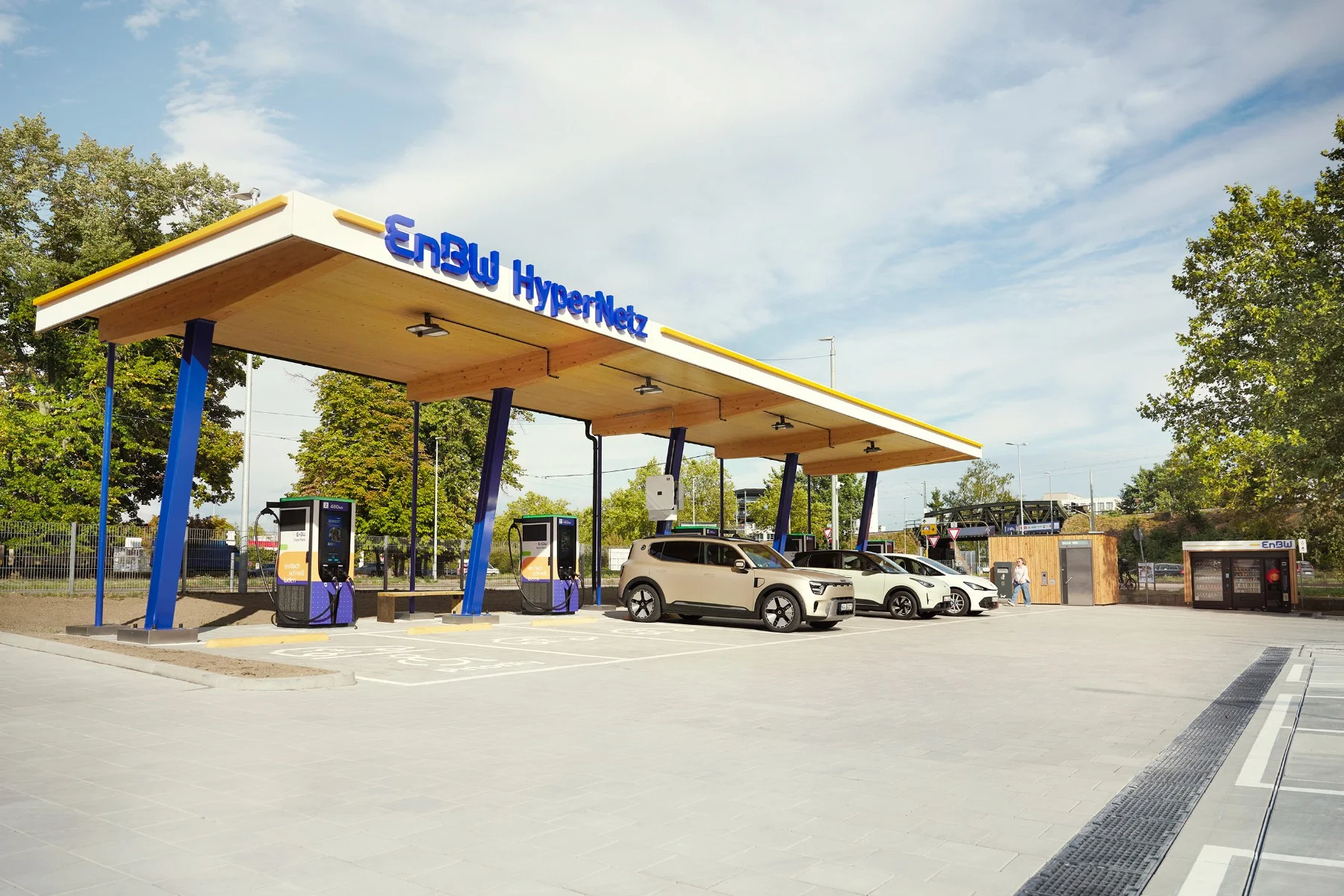
How EnBW Is Standardising High-Power Charging Site Integration with FLEXBOX
Validating a standardised local control and connectivity layer with Germany's largest fast-charging network operator
How EnBW Is Standardising High-Power Charging Site Integration with FLEXBOX
The Challenge
Scaling charging infrastructure in a complex grid environment
Building a high-power charging site is not simply a matter of installing chargers and connecting them to the grid. Each location has its own electrical design, available grid capacity, communication setup, and requirements from the local distribution system operator (DSO). The larger and more powerful the site, the more important it becomes to coordinate these elements reliably.
For an operator such as EnBW, this complexity multiplies across a large and diverse network. Charging hubs can contain multiple transformers, power meters, and dozens of charging points. Some locations also include photovoltaic systems or other energy assets. At the same time, sites must support different grid-control interfaces and satisfy site-specific connection agreements.
Without a standardised approach, every new location risks becoming a bespoke engineering project: hardware selected and assembled site by site, grid-control signals interpreted and translated individually, chargers and meters integrated separately, and testing and troubleshooting dependent on local expertise. In practice, this creates a handful of recurring barriers to scale:
- Longer deployment cycles — repeated engineering and approval work delays commissioning
- Higher complexity — multiple hardware components, interfaces, and suppliers multiply the potential points of failure
- Limited transparency — when data and control logic sit in different systems, it is hard to see why charging power was reduced or how a grid instruction was applied
- Inconsistent operations — different configurations across sites make support, maintenance, and upgrades harder
- Limited future flexibility — a solution built only for today's grid-control requirements may not be ready for tomorrow's energy-market use cases
EnBW needed more than a conventional load-management controller. The goal was a robust system for active-power control, with validated hardware and software interfaces able to progress through laboratory testing, field testing, and ultimately a broader rollout, while remaining ready for future capabilities such as reactive-power control, aggregation, and flexibility-market integration. Just as important was the operational model behind the technology: EnBW wanted greater data sovereignty and visibility into individual sites, with access to operational data, retrievable configurations, and enough transparency to understand load-management decisions without relying on manual support requests.
The Solution
FLEXBOX: a standardised local control layer for charging sites
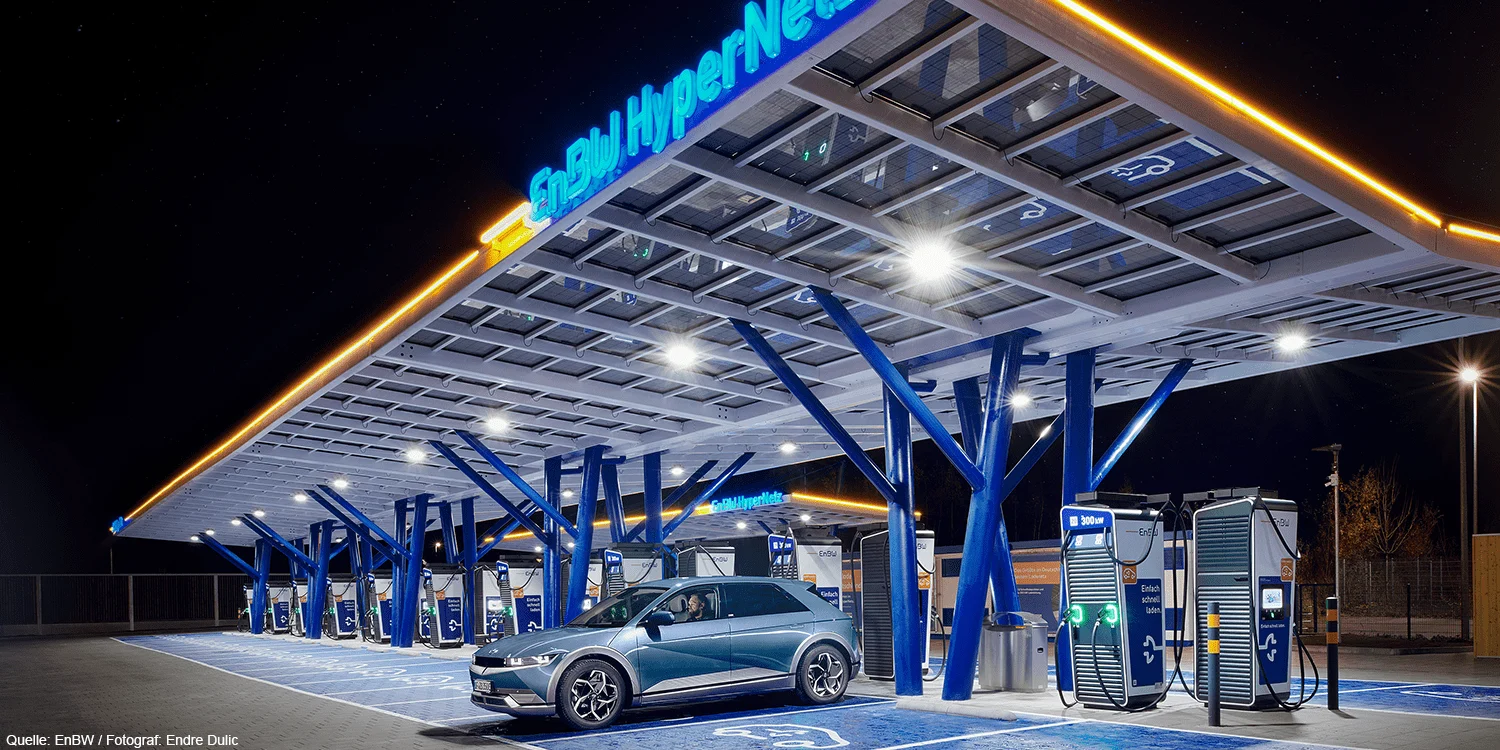
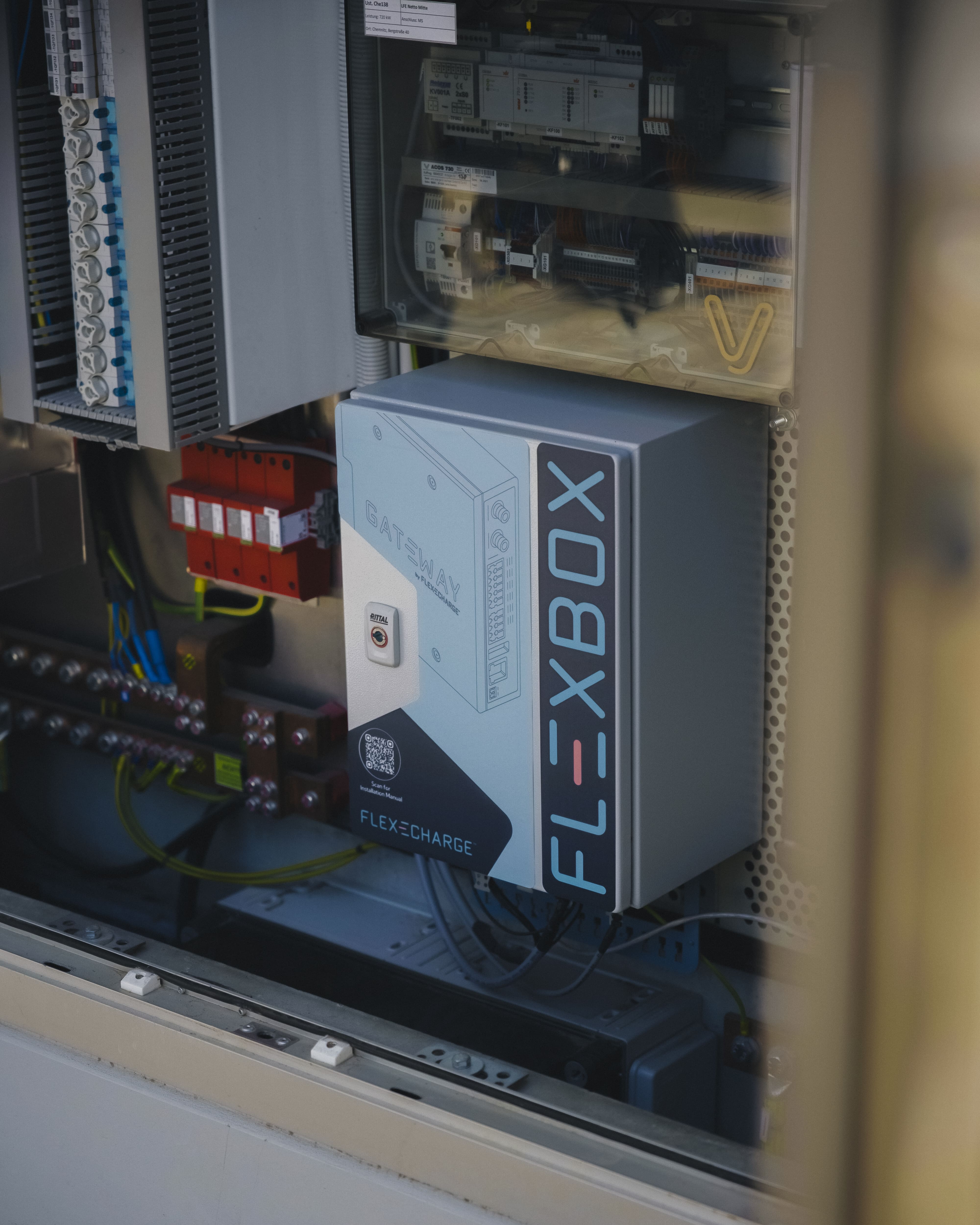
Together, EnBW and FLEXECHARGE have been developing the FLEXBOX: an industrial grid-management cabinet that connects the charging site, the grid operator, and the FLEXECHARGE software platform. Installed directly at the site, the FLEXBOX receives grid-control instructions, translates them into actionable power limits, and coordinates the connected charging infrastructure accordingly, while feeding operational data back to support monitoring, testing, and grid acceptance.
The solution combines the core components required for local energy and grid management:
- A FLEXECHARGE GATEWAY for control and decision-making
- An industrial Ethernet switch connecting chargers, meters, and other assets
- Analogue and digital input/output modules for grid-operator signals
- An industrial LTE router for secure connectivity
- An industrial power supply and a cabinet built for installation in charging-site electrical infrastructure
This reduces the need to design a new control system for every location. Instead, one consistent hardware architecture is configured for each site's topology and grid requirements. The FLEXBOX supports absolute and relative power setpoints, active-power limitation, and fail-safe behaviour, and it can receive grid-control commands through digital signals, analogue 4–20 mA interfaces, or Modbus, with corresponding feedback signals to the grid operator for deterministic, testable behaviour during grid events. It is designed to connect not just EV chargers, but power meters and, where required, PV inverters or battery storage, creating one common control point for the site rather than a collection of isolated devices.
Designed for repeatable deployment
The collaboration goes beyond a piece of hardware. EnBW and FLEXECHARGE are establishing a full deployment model covering hardware, software, configuration, testing, and operations. Through the HARMON-E platform, the FLEXBOX can be configured and supervised remotely: site parameters, charger settings, load-management rules, and grid-control behaviour are managed through a structured configuration flow, with device-management capabilities that help identify configuration changes and support consistent operation across the network.
The architecture is also built to give EnBW access to relevant site information. Operational and historical data can be integrated into EnBW's own systems, supporting greater transparency into power limits, charging allocations, grid activations, and site conditions, with event-based notifications flagging issues such as an offline site, a disconnected charger, or a failed meter.
Development has followed a validation process combining joint engineering, laboratory testing, and field testing, which matters in regulated grid environments where control behaviour has to be reproducible and every change has to be tested before deployment. That process covers load management, active-power control, hardware interfaces, site configuration, and IT integration. The result is a solution built to support German low- and medium-voltage grid requirements, including the relevant VDE application rules, with final settings and approval remaining subject to the local grid operator and the connection agreement for each site.
The Benefits
Faster, more consistent expansion.
A standardised control architecture can turn grid integration from a largely bespoke project into a repeatable deployment process. Once the design, interfaces, and testing procedures are validated, the same foundation can be applied across different charging-site configurations, reducing repeated engineering work, simplifying supplier coordination, and making lead times and rollout planning more predictable.
Reliable, grid-compliant control.
The FLEXBOX is designed to provide deterministic local behaviour even when connectivity to central systems is interrupted. Active-power limits can be implemented directly at the site, while fail-safe behaviour protects the grid connection and charging infrastructure. Support for digital, analogue, and Modbus interfaces lets the system work with the control methods used by different grid operators, without a completely different load-management architecture at every location.
Greater transparency and operational autonomy.
Centralised monitoring, retrievable configurations, and access to operational data are expected to give EnBW's teams a clearer picture of what is happening at each site. Instead of treating the control layer as a black box, operators can investigate why charging power was reduced, review the applicable configuration, and identify grid activations or equipment issues, shortening troubleshooting cycles and reducing dependence on manual support.
A lower total cost of complexity.
Standardisation is not only about hardware cost. A repeatable solution is expected to reduce effort across the whole site lifecycle, from engineering and acceptance testing to configuration, commissioning, support, maintenance, and upgrades. Using one principal control unit per site, with network extensions where required, avoids unnecessarily duplicating expensive control hardware, while a consistent bill of materials and defined QA process reduce variation between installations.
A foundation for smarter energy use.
The immediate focus is reliable load management and grid integration, but the same local control infrastructure is designed to prepare charging sites for more advanced energy use cases down the line, potentially including PV control, reactive-power management, peak shaving, spot-price optimisation, and participation in flexibility or balancing markets, with charging points prioritised according to defined business rules. That creates the potential to turn charging infrastructure from a passive electricity consumer into a controllable grid asset.
Next Steps
By combining EnBW's experience operating one of Germany's largest fast-charging networks with FLEXECHARGE's expertise in intelligent load and energy management, the collaboration aims to show how local standardisation can enable network-wide scale: faster deployments, more transparent operations, and charging infrastructure that is ready for the next generation of grid and energy-market requirements.
With the FLEXBOX as a common technical foundation, EnBW is positioned to replicate this standardised deployment approach across further sites as the field test progresses toward a broader rollout.
Features in Use
Solution & Benefits

Technical Overview
CHARGING HUB
8 x Alpitronic HYC300
MAX CHARGING POWER
2400 kW
GRID CONNECTION
3000 kW
CHARGING LIMIT
1800 kW*
PERFORMANCE PRICE
~45 €/kW
EXPECTED SAVINGS
30.000 € p.a.
Technical Overview
Locations
10
MAX CHARGING POWER
88-400kW per location
GRID CONNECTION
55-160kW per location
SOLAR PANELS
0-120kW per location
7 DC CHARGERS
0-1 per location
58 AC CHARGES
4-24 per location
Technical Overview
Locations
Hotel in Sassenheim
CHARGING STATIONS
10 AC (22 kW) + 3 DC (47 kW)
Energy Management
HARMON-E platform + Grid meter integration
GRID CONNECTIONS
524 kW
MAX CHARGING POWER
360kW
SOLAR CAPACITY
570 kW

"Scaling fast-charging infrastructure is no longer only a question of installing more chargers. It is increasingly a question of making each site easier to integrate, operate, and adapt to grid requirements. The FLEXBOX field test allows us to evaluate a standardised local control and connectivity layer under real operating conditions."
— Christian Dober,
High-Power Charging Infrastructure Product Manager, EnBW
Download the Team
Energie case
Download the Volvo
Trucks x Floading case
Download the case study
Can you monetize your network?
Download our Whitepaper to discover how VPPs work, why they matter for the EV charging sector, and how CPOs can benefit from this game-changing technology.
Discover the advanced technology behind
Join this session to learn how Recharge and FLEXECHARGE launched the first VPP on high-power public chargers, setting a new benchmark for the industry.

Scaling high-power EV charging despite complex grid requirements.
Learn how leading CPOs use the FLEXBOX to meet DSO grid control requirements, standardise site deployments, and roll out faster across Germany and Austria.
Register for the FLEXBOX on demand webinar
Turning grid complexity into a scalable advantage for high-power EV charging.
Learn how the FLEXBOX standardises grid compliance, simplifies DSO integration, and accelerates the rollout of high-power charging hubs without custom engineering or rollout delays.
Explore the FLEXBOX solution
.png)
Scaling high-power EV charging despite complex grid requirements.
Learn how leading CPOs use the FLEXBOX to meet DSO grid control requirements, standardise site deployments, and roll out faster across Germany and Austria.
.png)
Turning grid complexity into a scalable advantage for high-power EV charging.
Learn how the FLEXBOX standardises grid compliance, simplifies DSO integration, and accelerates the rollout of high-power charging hubs without custom engineering or rollout delays.

Webinar
Watch the on-demand masterclasses series about our Broker Architecture
Don't miss this opportunity to discover how broker architecture can optimise your charging operations, reduce costs, and position your CPO business for future success.
Interesting reads
.jpg)
.jpg)
September 2026: Financing Innovation Reshapes EV Charging
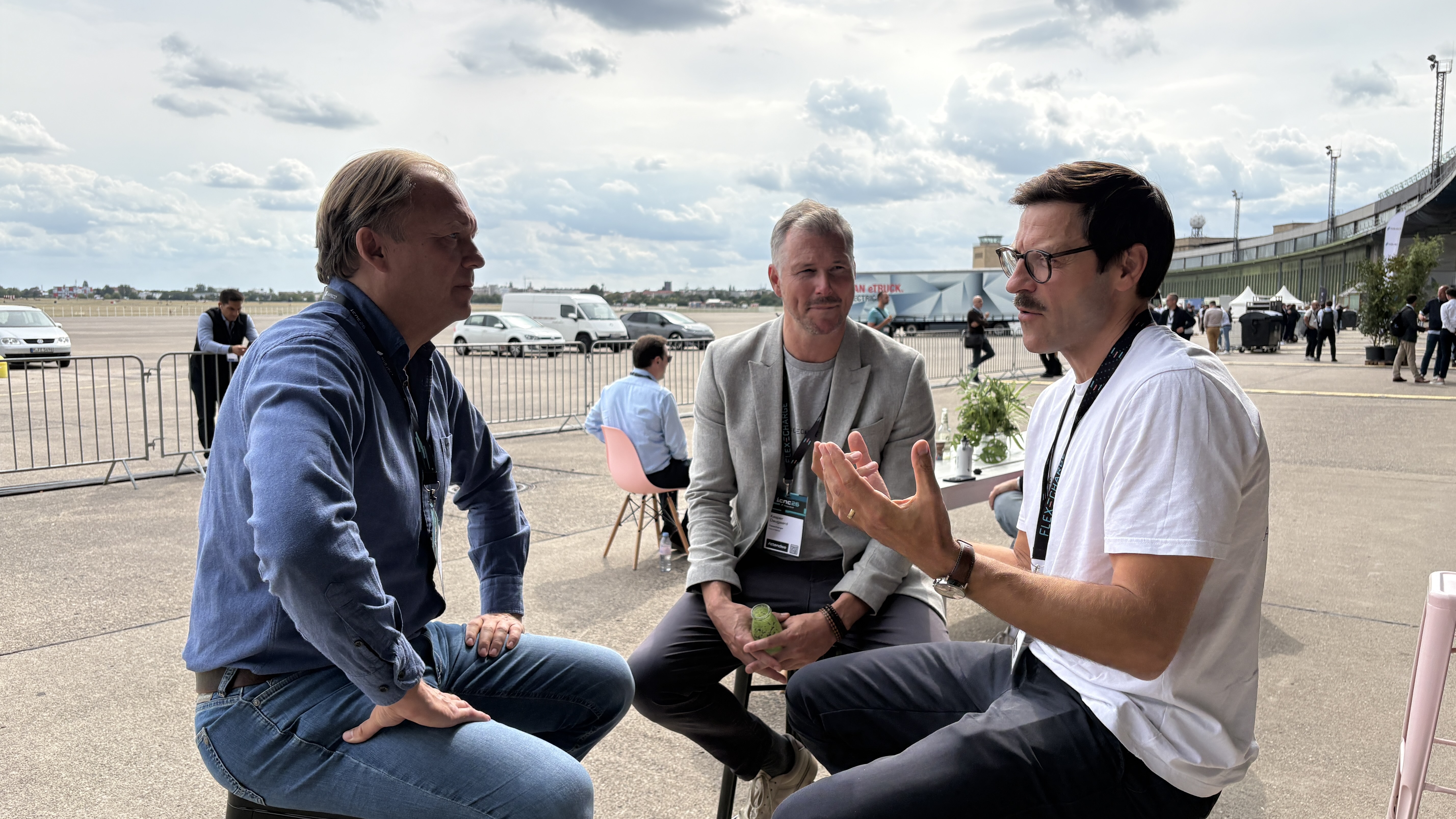

EV Charging's Next Bottleneck Isn't the Charger - It's Everything Around It
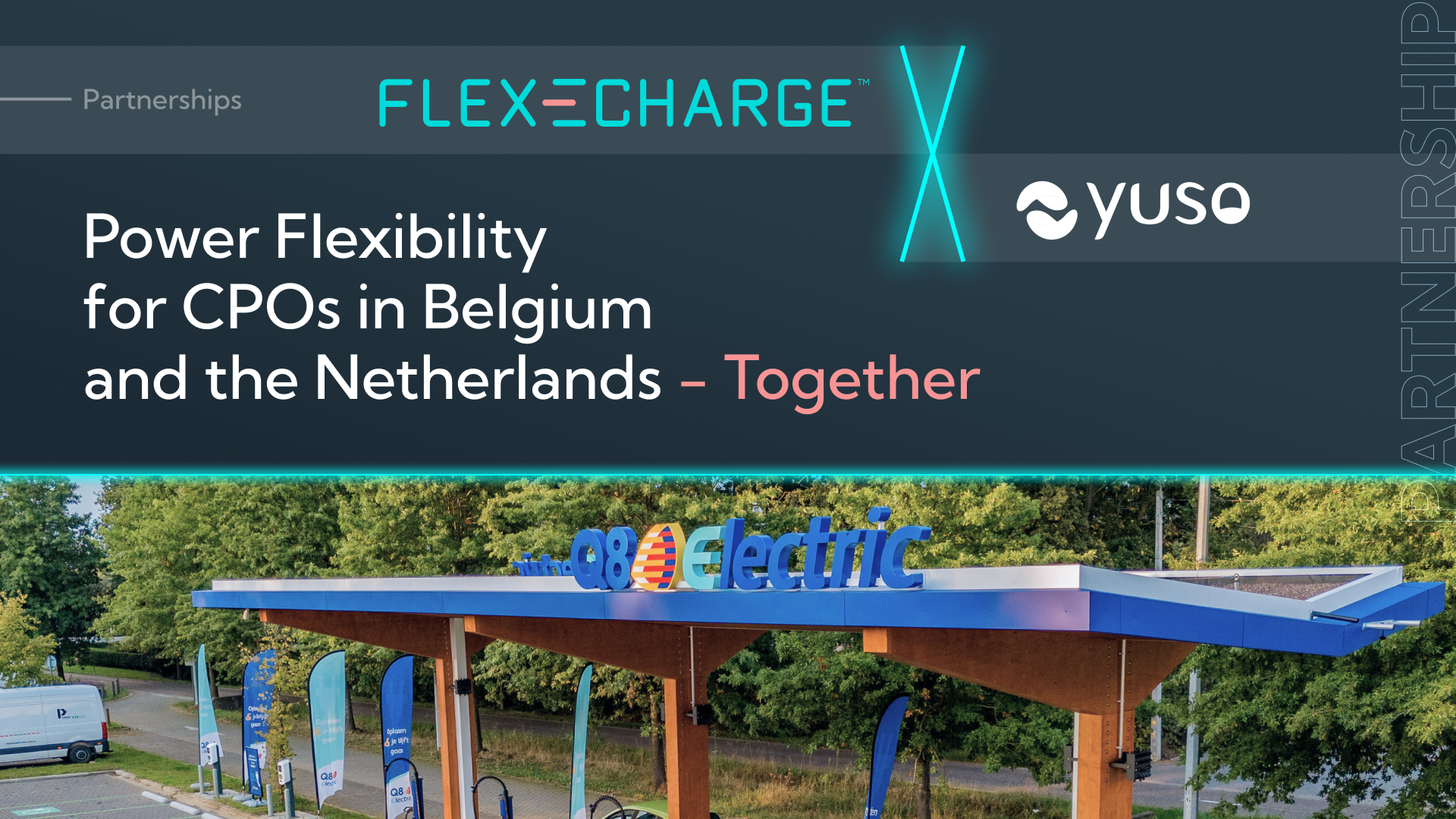
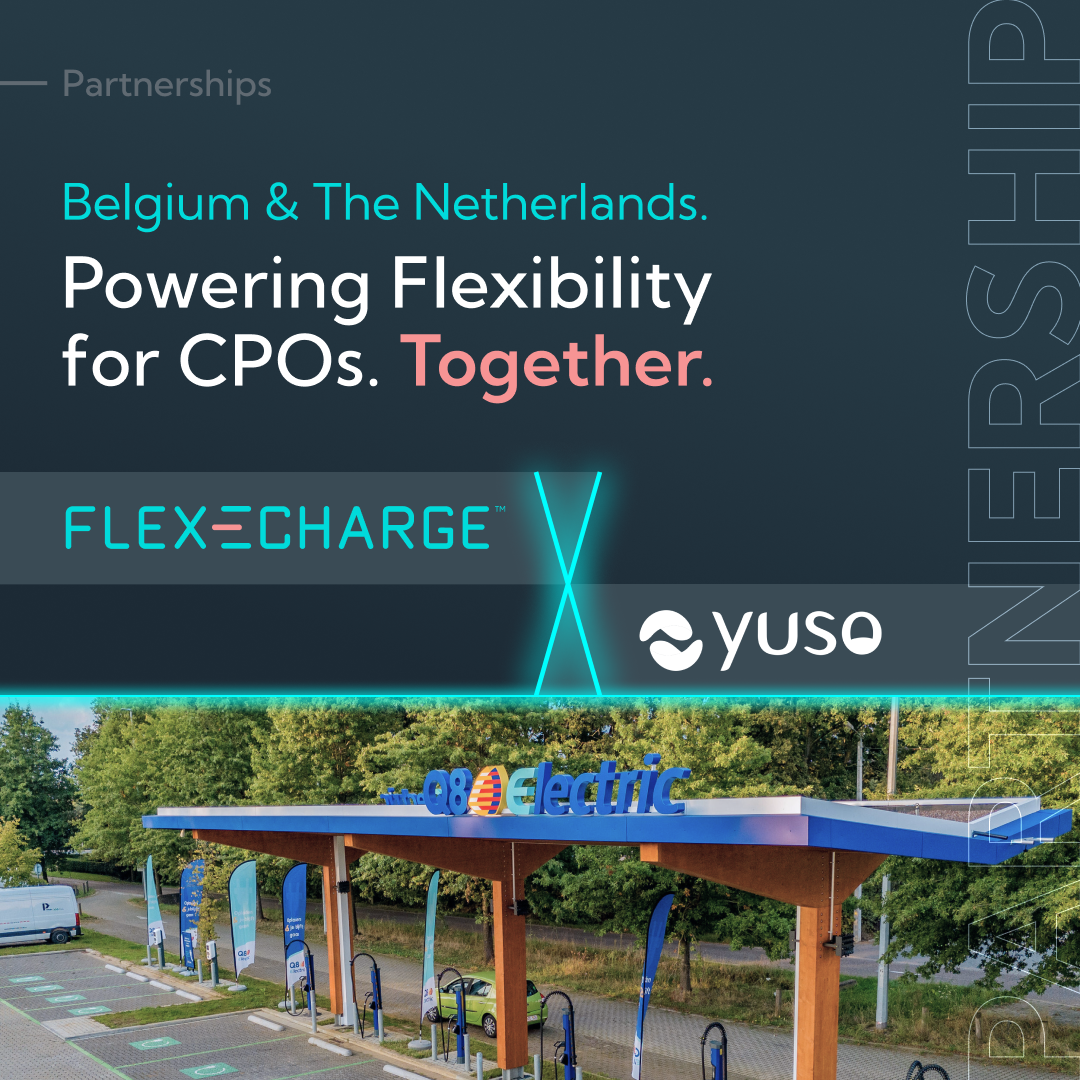
Battery Flexibility Revenue for CPOs in Belgium and the Netherlands: FLEXECHARGE and Yuso Join Forces
.jpeg)
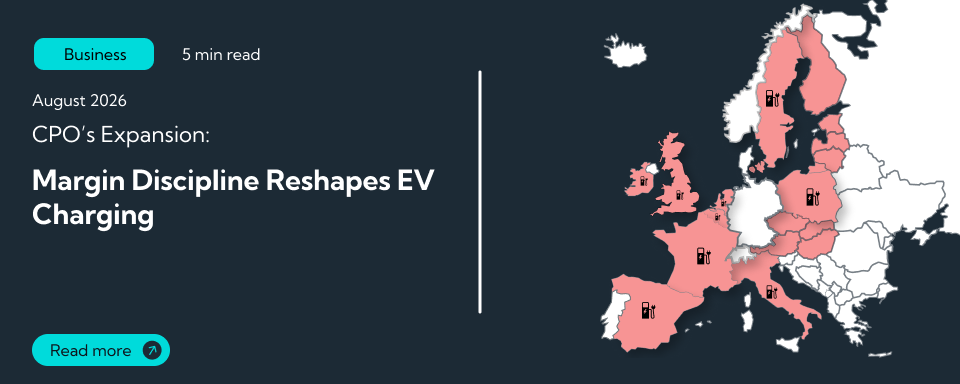
August 2026: Margin Discipline Reshapes EV Charging
Get started with
FLEXECHARGE
Contact our team to learn more about what we can help you achieve with our open, vendor agnostic platform and powerful solutions.